
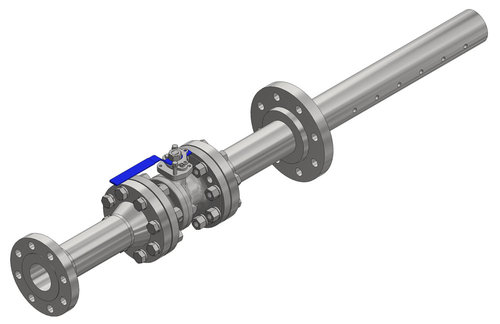
Accurate level measurement is essential in water systems, industrial tanks, and process environments where turbulence and wave action can distort readings. A stilling well is one of the most reliable and time-tested solutions used to stabilize liquid level measurements.
From hydrological monitoring stations to industrial process vessels, stilling wells play a critical role in ensuring sensors, gauges, and instruments receive a calm, representative measurement of the actual liquid level.
At Aircom, stilling wells are part of our Process Piping and Fittings product group, manufactured to meet the specific needs of industrial, municipal, and monitoring applications across North America.
A stilling well is a vertical pipe, chamber, or standpipe connected inside a tank, reservoir, or water body that allows liquid to enter slowly through small openings. This controlled exchange of liquid dampens turbulence, waves, and rapid fluctuations so instruments can measure a stable level instead of a constantly moving surface.
At its core, a stilling well is:
Advantages
Limitations
Why this matters
In practical terms, the stilling well acts like a buffer between turbulent process conditions and measurement instruments. Instead of trying to measure the liquid surface directly in a moving environment, instruments measure the calm level inside the stilling well.
Stilling wells are widely used across industries where reliable level measurement is critical.
Common applications include:
Because natural and industrial systems rarely have perfectly calm surfaces, stilling wells provide a simple but effective engineering solution.
The material used to manufacture a stilling well depends on environmental conditions, structural requirements, and corrosion exposure.
Common materials include:
The stilling well material must match both the hydraulic function and the structural or pressure demands. Vented, atmospheric wells may use concrete, PVC, HDPE, or steel. Pressure‑containing wells require steel, stainless steel, or FRP designed to applicable pressure vessel codes. Long‑life permanent stations typically use concrete or steel.
Selecting the right material ensures long service life, reliability, and compliance with operating conditions.
In some installations, stilling wells are pressure-containing components rather than simple atmospheric chambers.
When a stilling well can experience internal pressure above approximately 15 psi, it must be designed according to pressure-vessel codes rather than hydrometric guidelines.
Key design standards include:
These standards govern critical design factors such as:
Typical Design Requirements for a Pressure‑Containing Stilling Well
The moment a stilling well can contain pressure, it stops being hydrometric equipment and becomes a pressure vessel. The governing standards are ASME BPVC Section VIII in the United States, and ASME Section VIII together with CSA B51 in Canada.
Aircom designs and manufactures stilling wells as part of our Process Piping and Fittings product group, supporting industrial applications that require reliable level measurement and durable piping components.
By manufacturing these components to order, Aircom helps engineers and operators obtain solutions that match the exact requirements of their systems rather than relying on generic equipment.
Aircom has the ability to obtain a Canadian Registration Number (CRN) working under the organization's scope permitted by the pressure equipment safety authority - ABSA.
To learn more about our designs and specifications, visit: Aircom Stilling Wells and Level Chambers
Across industries, a stilling well goes by several different names. The term used usually depends on discipline (hydrometry, process, marine, industrial) and function (level measurement, damping, protection, or guidance).
Common alternate terms include:
Hydrology and Water Resources
These terms are commonly used by river-monitoring agencies such as the USGS and the Water Survey of Canada.
Instrumentation and Process Control
Marine and Coastal Applications
Storage Tanks and Vessels
Municipal and Water/Wastewater
Pressure and Piping Context
Related but Distinct Terms
These terms are sometimes confused with stilling wells, but describe different equipment:
While terminology varies, the function remains the same: calming liquid movement to allow accurate measurement.
A stilling well reduces turbulence, waves, and rapid liquid movement so measurement instruments can read a stable and accurate liquid level.
Common instruments include float level gauges, radar level transmitters, pressure sensors, shaft encoders, and staff gauges.
A stilling well is recommended whenever liquid surfaces are turbulent, such as in rivers, tanks with agitation, pump stations, or flowing channels.
They can be. If the stilling well is isolated or exposed to pressures above approximately 15 psi, it must be designed according to pressure vessel codes such as ASME BPVC.
Material selection depends on the environment and pressure conditions. Carbon steel and stainless steel are common for industrial use, while concrete or PVC may be used in hydrological monitoring installations.
A stilling well typically stabilizes liquid for measurement in open water or tanks, while a level chamber is commonly used in process instrumentation to house level transmitters connected to a vessel.