
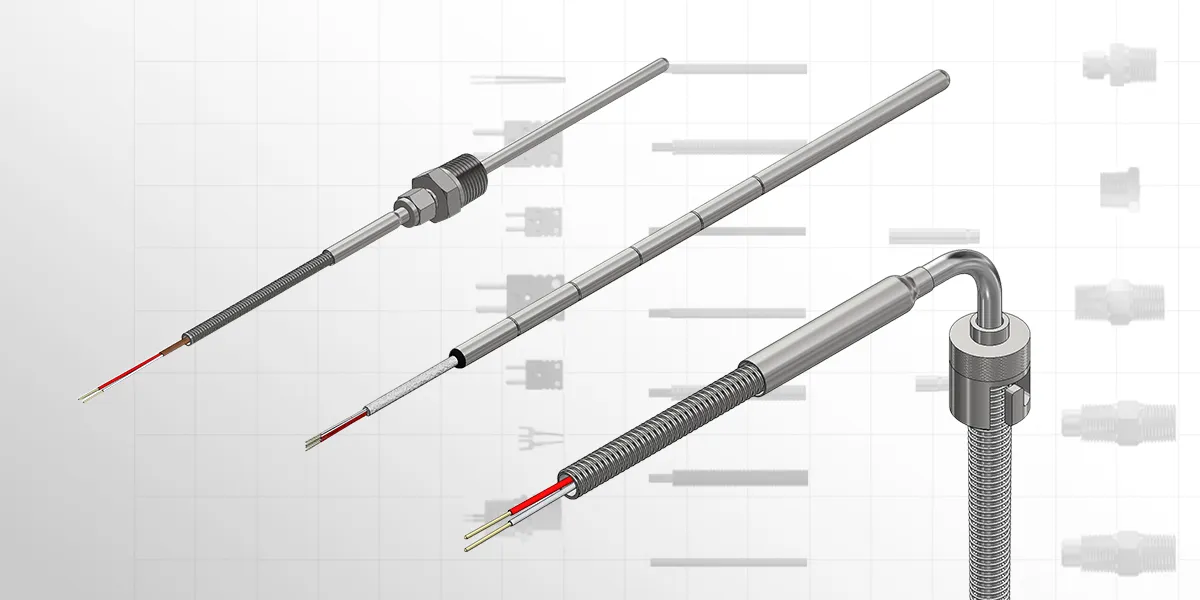
Standard catalogue temperature probes or Commercial off-the-shelf sensors, also known as COTS sensors, may be cost-effective, easy to order, and often suitable for straightforward industrial temperature measurement. But in demanding process environments, “standard” may not suit, and can become expensive very quickly.
When an off-the-shelf temperature sensor fails prematurely, the real cost is rarely the part itself. The bigger cost is downtime, troubleshooting, lost production, unreliable readings, repeated replacements, and the risk of making process decisions with incomplete or inaccurate temperature data. That is where custom temperature probes matter.
For engineering procurement managers, plant reliability teams, and instrumentation engineers, the goal is not simply to buy a sensor. The goal is to specify a temperature measurement solution that fits the process, survives the environment, and delivers reliable data over time.
Aircom builds custom RTD sensor probes, thermocouple sensor probes, multipoint temperature sensors, surface-mount temperature sensors, tube metal temperature sensors, and related temperature assemblies for real-world industrial applications where off-the-shelf just does not cut it.
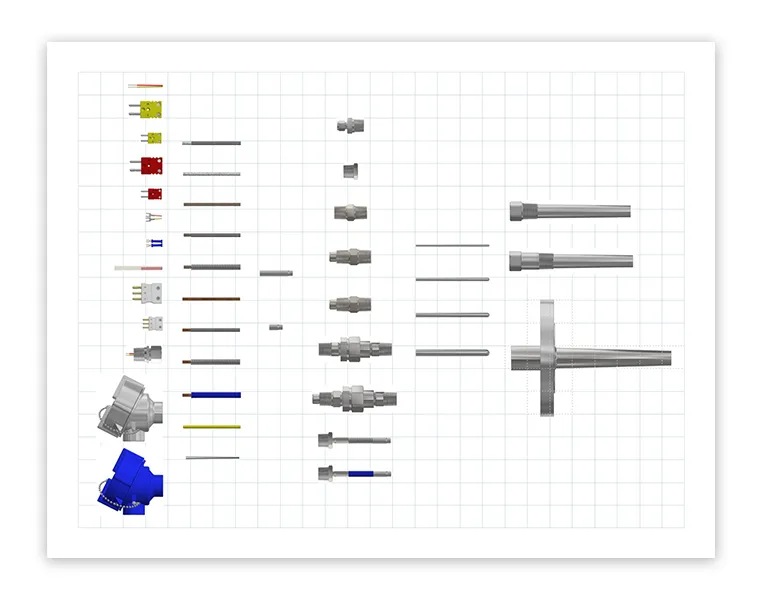
Not every application needs a custom sensor. But when the process is demanding, the environment is harsh, or standard assemblies continue to fall short, it is time to look beyond the catalogue.
Temperature sensors are often pushed into applications where heat, pressure, and cycling can challenge standard designs.
Basic Type K thermocouples and standard Pt100 RTDs may be useful in many applications, but they still need the right construction around them. Element selection is only one part of the design. The sheath, connection, insulation, wiring, fittings, junction, and installation style all influence performance.
In these environments, sensor performance depends on more than the sensor type. It depends on the entire assembly.
Process media compatibility is one of the most important reasons to choose a custom temperature probe.
In corrosive, erosive, or chemically aggressive environments, the wrong material can lead to premature sheath failure, contamination, leakage risk, and unreliable measurement. Standard stainless steel may not be enough.
Custom probes allow engineers to specify materials that fit the service. Material selection should consider temperature, pressure, fluid chemistry, velocity, abrasion, corrosion risk, and expected service life.
Some installations are difficult simply because the physical space does not match a standard product.
A probe may need to fit around piping bends, limited clearances, insulation, connection head restrictions, existing thermowells, vessel nozzles, surface geometries, or retrofit conditions. In hazardous locations, the design may also need to account for approved components, field wiring, connection heads, and site-specific safety requirements.
In these cases, forcing a standard sensor into the application can create more problems than it solves.
A custom probe is not just a different length or fitting. It is a complete temperature measurement assembly designed around the process.
The right design considers sensor technology, sheath construction, mounting style, installation method, response time, electrical connection, environmental exposure, compliance needs, and the realities of field maintenance.
The first major decision is choosing the right sensing element.
RTDs are often preferred when accuracy, repeatability, and long-term stability matter. They are commonly used in applications where tighter measurement performance is required and process conditions are within the appropriate temperature range.
Thermocouples are often preferred when the application involves higher temperatures, faster response needs, rugged environments, or broader operating ranges. They are commonly used across demanding industrial applications because they are durable, versatile, and well-suited to harsh service.
The goal is to select the element that best fits the measurement objective, not just the one that appears most common on a datasheet.
The sheath is the probe’s first line of defence.
Its job is to protect the sensing element while allowing temperature to transfer accurately and efficiently. A poorly selected sheath can slow response time, increase failure risk, or expose the sensor to conditions it cannot survive.
For harsh industrial environments, sheath optimization can be the difference between a sensor that survives and one that becomes a recurring maintenance issue.
Some applications require more than a single probe.
Custom temperature measurement can involve assemblies built to monitor multiple points, measure surface temperature, protect sensors in process streams, or capture tube metal temperature in high-heat environments.
Aircom’s custom capabilities support a wide range of advanced configurations.
Multipoint temperature sensors are especially useful when multiple temperature readings are required from a single connection point. These assemblies can support temperature profiling in reactors, vessels, towers, tanks, catalytic systems, and other process environments where one measurement point is not enough.
Surface-mount temperature sensors are useful when the surface temperature itself is the desired measurement, or when surface temperature is used as a correlation to process temperature.
Tube metal temperature sensors, such as Aircom’s BTB and BTB2 designs, are built for applications where direct and reliable surface temperature measurement matters in high-heat environments.
Custom temperature probes are not only an engineering decision. They are a business decision.
When a probe is designed correctly, it can help reduce downtime, improve measurement confidence, extend service life, and simplify maintenance planning. For operations teams, that means fewer surprises. For procurement teams, it means fewer repeat orders caused by premature failure. For engineers, it means a solution that better matches the application.
When a temperature sensor fails, waiting weeks for a replacement can create serious operational pressure. Aircom’s localized manufacturing and culture of urgency help support quick lead times.
Speed matters, but so does getting the design right. A fast replacement that repeats the same failure pattern is not a solution. The better approach is to respond quickly while also solving the underlying application problem.
Industrial temperature measurement often requires more than a functional sensor. It may require documentation, traceability, compliance, and confidence that the assembly has been built for the required service.
Depending on the application, that may include:
These details matter in regulated, hazardous, high-pressure, or safety-sensitive environments where the cost of non-compliance can be significant.
The best custom probe solutions start with the application.
Instead of forcing customers into a generic catalogue part, Aircom works through the process conditions, failure history, installation constraints, compliance needs, material requirements, and measurement goals.
This collaborative approach helps move the conversation from “what part do you need?” to “what problem are we solving?”
Custom probes are used across many industrial sectors where process reliability and measurement confidence matter.
Typical applications include:
Across these applications, the common thread is simple: the process conditions determine the sensor design.

Off-the-shelf temperature sensors can work well in standard applications. But when the environment is harsh, the process is critical, the installation is unusual, or the same sensor keeps failing, “close enough” becomes an operational risk.
A custom temperature probe is not about overengineering. It is about matching the measurement solution to the real-world conditions it has to survive.
If your process requires specialized engineering, the right custom probe can improve reliability, reduce downtime, and give your team more confidence in the measurement.
Need a custom temperature probe for your application?
Contact the Aircom team to discuss your process conditions, request a custom quote, or share your technical specifications.
Explore Aircom Products and Services:
https://www.aircominstrumentation.com/overview-products-and-services